Supply Chain Interoperability and Integration for the Industrial Internet

Evidence that your supply chain data is interoperable and automation-ready. Register today.

Any buyer system – including AI procurement agents – will be able to read, interpret, and act on your catalog, supplier profile, and facilities data
ECCMA-certified ISO 25500 conformance badge, Type I, supply chain interoperability
ECCMA-certified ISO 25500 conformance badge, Type II, supply chain interoperability

Your organization can actively exchange and verify supply chain data using the ISO 25500 API that is at the heart of the Industrial Internet

ECCMA-certified ISO 25500 conformance verifies that an organization’s supply chain data conforms to the international standard for Supply Chain Interoperability and Integration.

AI procurement agents, ERP automation, and digital sourcing tools are only as reliable as the data they act on.

ECCMA certification of ISO 25500 conformance is independent evidence of your organization’s ability to provide standardized supply chain data that is interoperable and automation-ready.

Trusted, standardized, automation-ready data

Verified item/supplier identity, every system

Onboarding: weeks to hours

Purchase order errors minimized

Built for suppliers and manufacturers whose data needs to be trusted by buyer systems, whether automated, AI-equipped or not.

THE MARK FOR INTEROPERABLE AND AUTOMATION-READY DATA

With the ECCMA-certified mark, organizations confirm their capacity to conform to ISO 25500. The mark is an important indicator to buyers, procurement platforms, and trading partners that your data can be formatted to the international standard and ready for automated and AI-supported systems.

One of the most widely recognized and entrenched problems in the supply chain today is the challenge of exchanging data without losing meaning.

Products are described differently from one system to the next, and one company to the next. Even if the data you have is well structured, it isn’t always obvious where to verify it as correct and current. The terms used for items’ attributes and values may not have the same meaning to the parties exchanging data, and that scenario magnifies across AI-supported or automated systems. Suppliers use legal names, trade names, various types of identifiers that makes it complex to know who you are, in fact, doing business with – and that they are who they say they are. Identifying exactly which facility a product is manufactured in and shipped from is  especially challenging with new company expectations and government regulations related to tariffs, sanctions and other measures. Even knowing when a transaction happened is complex, when businesses in some countries format their date as DD-MM-YYYY, others as YYYY-MM-DD, and some as MM-DD-YYYY.

Using these simple standardized formats, you can solve all of these problems: data becomes unambiguous, portable, interoperable, and inherently designed to be shared, compared, and trusted across organizations, sectors, and borders.

Only 36% of CPOs are very confident in their ability to redesign for AI (Gartner, 2026). The gap isn’t ambition – it is data that was built to survive a human checking it, not a machine acting on it alone.

When a person reviews data, small inconsistencies can get caught and fixed without anyone noticing: a facility address confirmed by phone, a mismatched supplier ID reconciled across two ERP instances, an ambiguous item spec sheet double-checked before the order goes out.

Remove that person – hand the same data to an AI agent or an automated system – and no-one catches the ambiguity. It becomes a wrong order, an unverified supplier approved without proper checks, or an inaccurate compliance record, executed automatically and at scale.

The risk to suppliers isn’t reputational – it is operational. Data that is not structured to a common standard means slower onboarding, more rejected orders, and a growing chance of being filtered out of automated RFQ and sourcing pipelines before a person ever sees the bid.

If your procurement, ERP, or sourcing systems are automating supplier intake and vendor qualification, you need a scalable way to know a supplier’s data can be trusted – without a person manually vetting each one.

The ECCMA-certified ISO 25500 conformance mark is that signal. A certified supplier is independently evidenced to be able to provide structured, unambiguous, and machine-readable data that your systems can read, interpret, and act on. Achieving the conformance mark is a step toward exchanging data with your trading partners using the Industrial Internet which can support you to…

  • Screen for certification status in supplier onboarding and RFQ evaluation, the same way you already screen for insurance or financial standing
  • Reduce manual reconciliation work — verified identity, credentials, and item data cut reconciliation effort
  • Build your own audit trail for ESG, trade compliance, and regulatory due diligence
  • Reduce risk in your AI procurement deployment — certified suppliers are a trusted source your AI agents and automation can act on first

If you are a Consultant, Application Provider or System Integrator, speak with ECCMA about how you can assist your clients’ readiness for ISO 25500 conformance Certification, ISO 25500 implementation, and supply chain data transformation.

TWO CERTIFICATION TIERS, ONE STANDARD

ECCMA-certified ISO 25500 conformance is a data assessment. Successful certification entitles the organization to display the ECCMA-certified ISO 25500 conformance mark.
ECCMA-certified ISO 25500 conformance badge, Type I, supply chain interoperability

TYPE I — SUPPLY CHAIN INTEROPERABILITY

$500

Scope: data format and structure conformance

What it confirms

Any buyer system — including AI procurement agents — can read, interpret, and act on your data. You can share your catalog, supplier profile, and compliance records in a format ready for automated intake.

Supply chain data provision can be enhanced

  • Wrong-parts errors eliminated — item specs verified with you at source before your trading partner orders
  • Supplier and facility identity in standardized format and verified across buyers’ ERP instances, business units, and borders
  • Catalog data can load directly into buyer systems without cleansing – standardized and interoperable
  • Clearer data for ESG, trade compliance, and regulatory due diligence

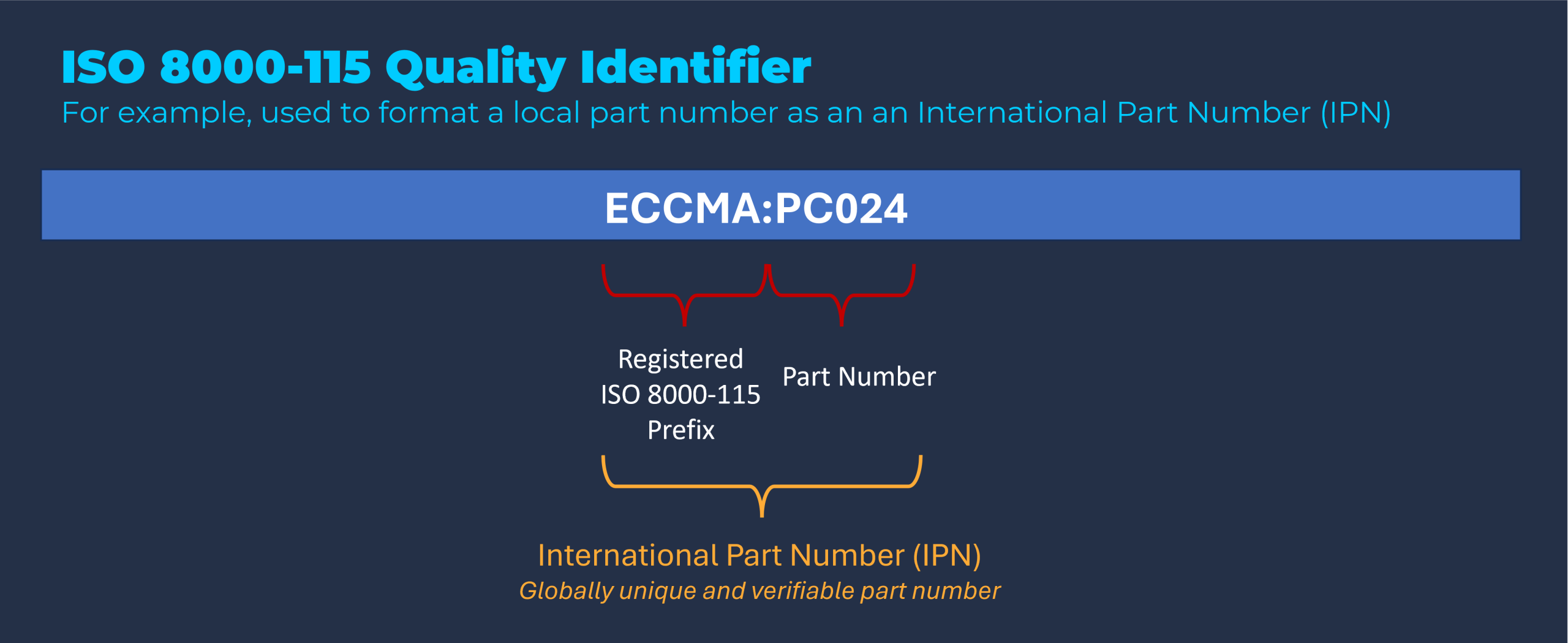
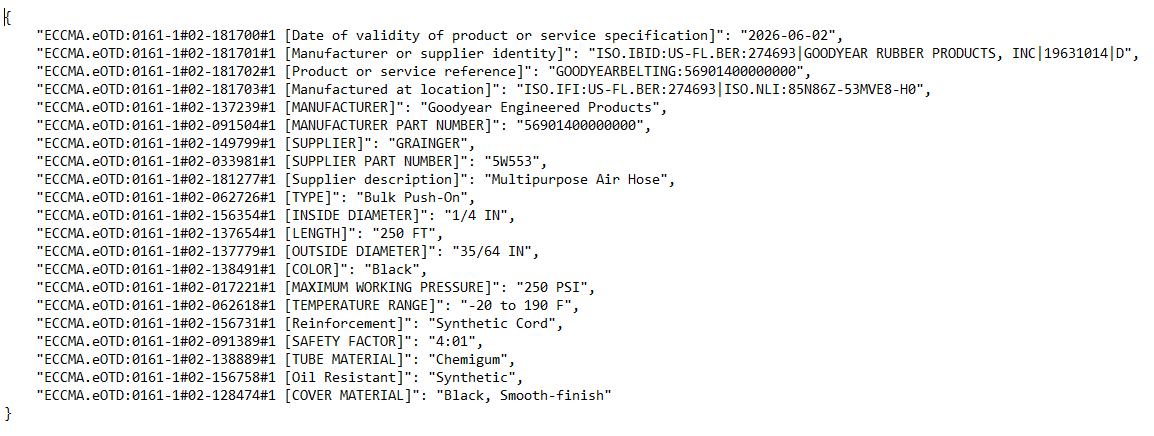
Type I requires submission of a product or service specification in ISO 8000-114 format, including a validity date, supplier identity, location identity, and item identifier that includes a registered ISO 8000-115 formatted SmartPrefixâ„¢.

ECCMA-certified ISO 25500 conformance badge, Type II, supply chain interoperability

TYPE II — SUPPLY CHAIN INTEGRATION

$1,000

Scope: all Type I requirements plus live API data exchange

What it confirms

Your organization can actively exchange and verify supply chain data using the ISO 25500 API that is at the heart of the Industrial Internet.

The Industrial Internet enables frictionless, trustworthy querying of authoritative sources throughout your supply chain to confirm vendor identity, item specifications, and credential data at any stage of your process.

Supply chain data provision via active participation in the ISO 25500 Industrial Internet means…

  • AI procurement agents and ERP automation can operate on current, verified, standardized data – reliable decisions, not amplified errors
  • Supplier onboarding accelerates based on trusted, verified supplier identity and item specification data
  • Sourcing and vendor qualification from verified, authoritative data that buyers know they can trust.

Type II additionally requires an active Industrial Internet subscription with registered API endpoints (for example via VDSAI), and a demonstration that your systems can submit Search, Resolve, and Verify requests using the ISO 25500 API.

Type I certifies that your supply chain data – organizations, locations, facilities, and items – is structured and formatted to the ISO 25500 standard: unambiguous, machine-readable, and verifiable.

You must upload a file that contains the following:

  1. Date formatted in accordance with ISO 8601
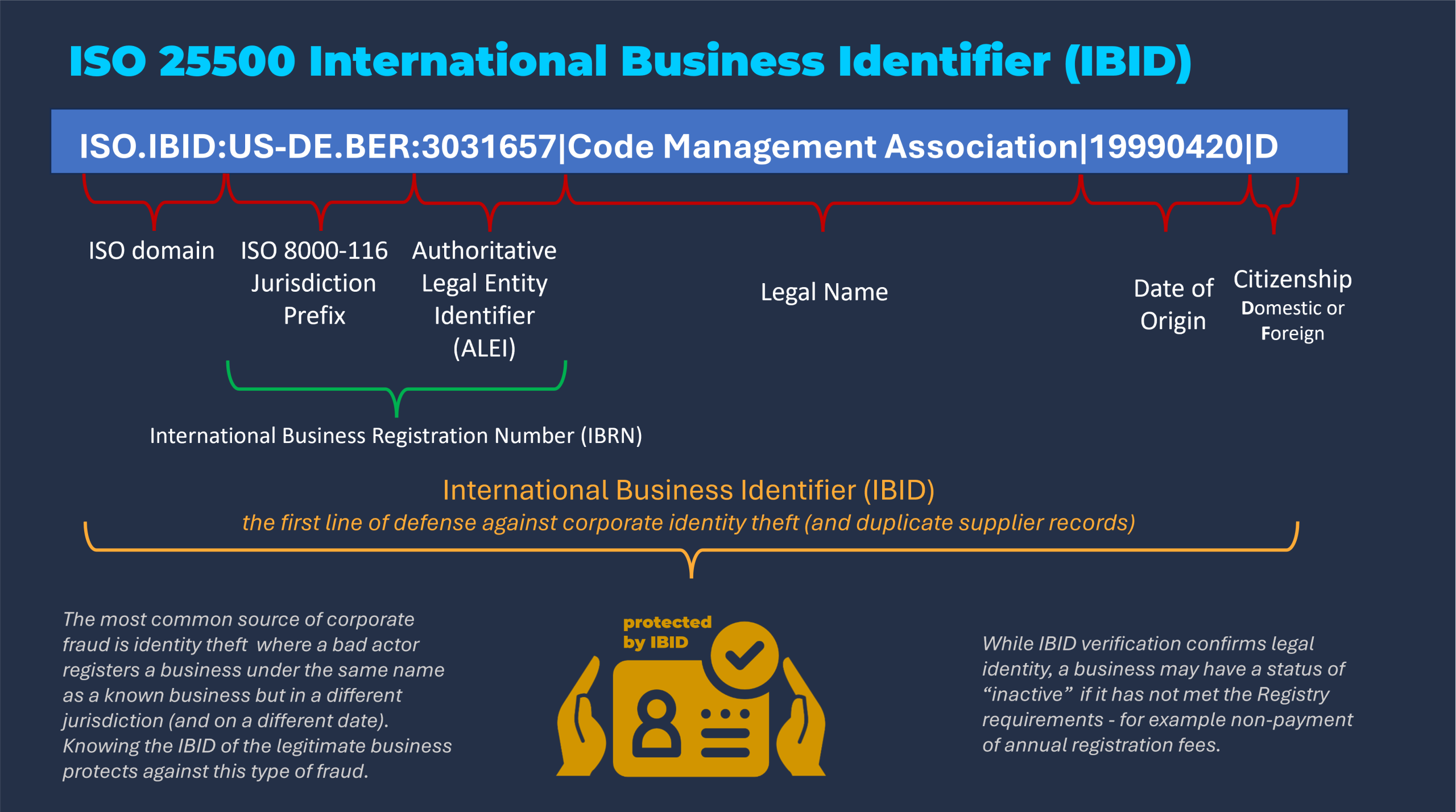
  2. Manufacturer or supplier identity identified using the ISO 25500 International Business Identifier (IBID)
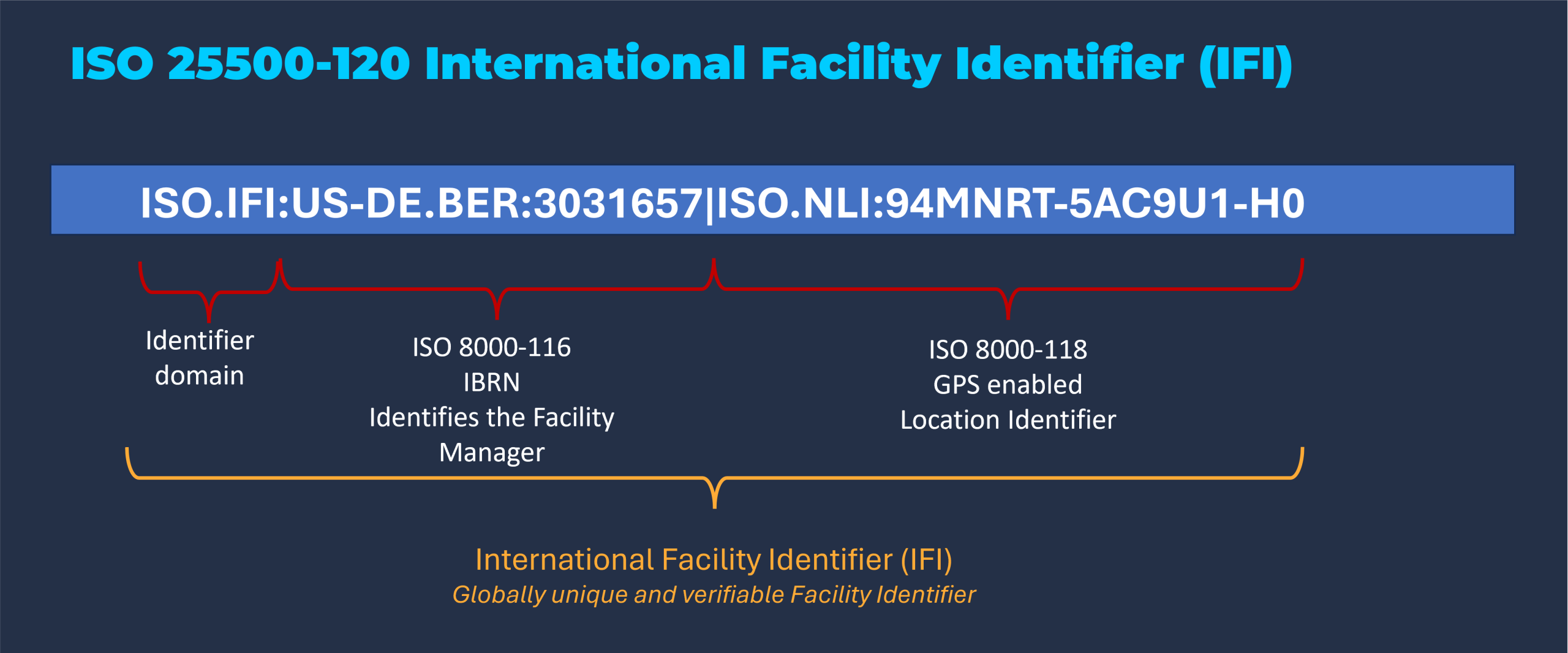
  3. Manufactured at location identified using the ISO 25500 International Facility Identifier (IFI)
  4. Product or service reference formatted using a registered prefix and items identified using ISO 8000-115 formatted quality identifiers
  5. Items described using ISO 8000-114 formatted specifications

Certification confirms:

Your data can be read, interpreted, and acted on by your trading partners. For example, your catalog data and supplier profile are ready for automated intake.

Type II certifies that your automated systems can actively exchange and verify supply chain data using the ISO 25500 API – querying authoritative sources to confirm supplier identity, item specifications, and compliance credentials.

You must demonstrate that your data and applications:

  1. Meets the data formatting requirements of Type I certification
  2. Can send request for identifier resolution
  3. Can respond to request for identifier resolution

All data format and structure requirements from Type I are included in Type II scope and must be met in full.

Certification confirms:

Your organization can participate actively in the ISO 25500 Industrial Internet – verifying data and being verified across the automated supply chain. AI procurement agents, ERP automation, and digital sourcing platforms can trust the source of authoritative data.

Certification confirms conformance to the standard. Vital supply chain performance outcomes result from ISO 25500 implementation – certification is the independent evidence that your data meets it.

ISO 25500 is an international standard published by ISO. ECCMA is an independent certification body assessing and certifying conformance to it.

FREQUENTLY ASKED QUESTIONS
ECCMA-certified ISO 25500 conformance is an independent credential confirming that an organization’s supply chain data conforms to the ISO 25500 international standard for supply chain interoperability and integration.

Type I certifies that your supply chain data is formatted and structured to the ISO 25500 standard. Type II includes all Type I requirements plus certifies that your systems can actively exchange and verify data using the ISO 25500 API.

Type I certification costs $500. Type II certification costs $1,000 and includes all Type I requirements. Both are issued following an independent assessment.

Not directly. ISO 25500 certification attests to data format and machine-readability only — it does not verify local content, domestic sourcing, or country of origin, and does not itself satisfy regional trade policy initiatives like IKTVA, Buy American Act, EU Industrial Accelerator Act, or similar localization regimes. However it does confirm a standardized data foundation that supports and speeds up documenting compliance with them.

Yes. An ISO 8000-115 formatted SmartPrefixâ„¢ is required for both Type I and Type II certification.

→ Research a SmartPrefix™ 

The Industrial Internet Podcast

Learn more about ISO 25500 and the Industrial Internet – Listen on Spotify

ISO 25500 standard

Get the ISO 25500 standard from ISO

supply chain master data automation and verification via ISO 25500

Discover the Industrial Internet – the automated supply chain enabled by ISO 25500

Forbes Industrial Internet article, April 2026

The New ISO Standard That Will Solve The World’s Messiest Data Problem